
NDIS support worker rostering: screening, travel and timesheet checks
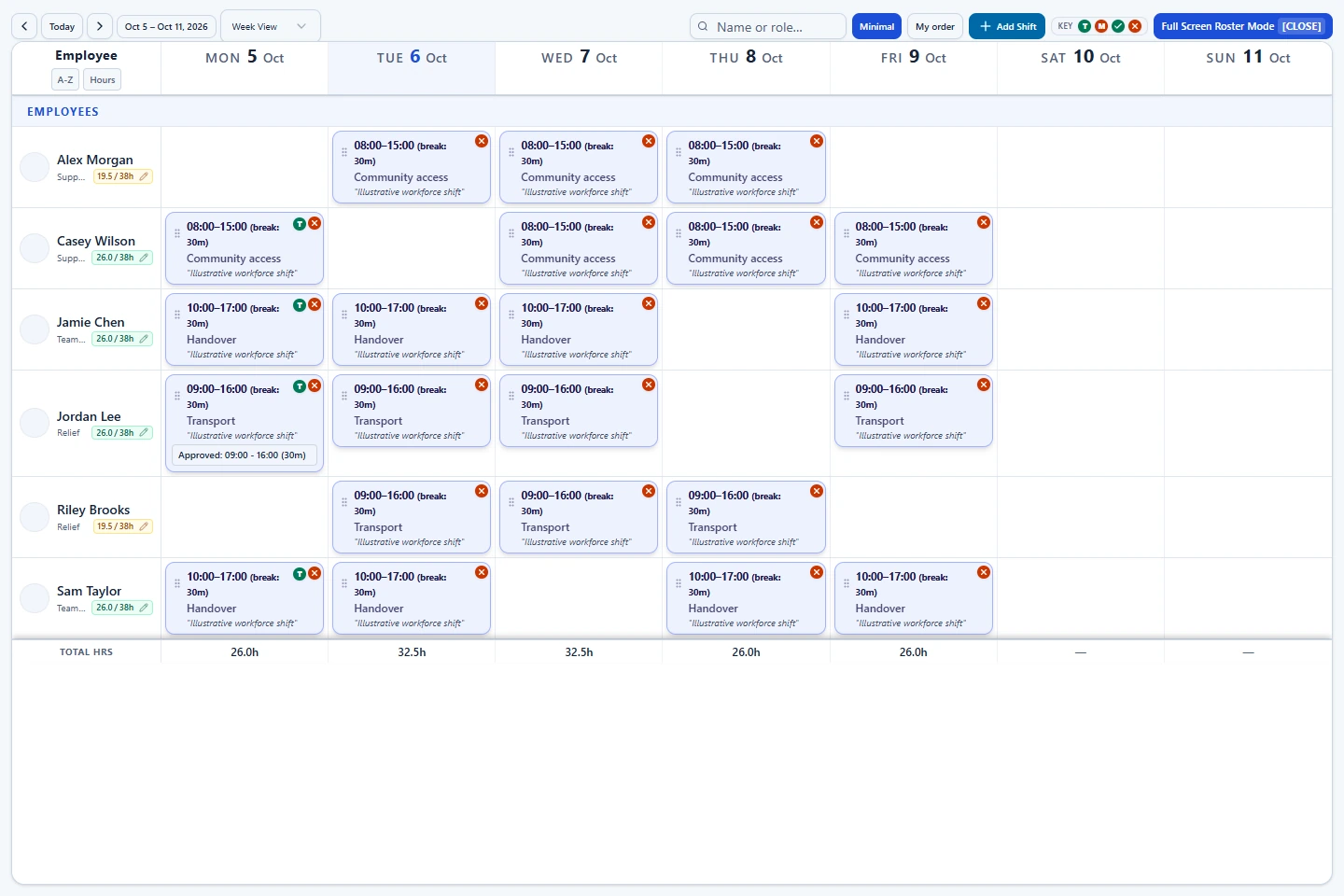
An NDIS roster has to do more than fill a time slot. The worker needs to be suitable for the role, the support needs to be covered, travel has to be workable and the resulting time has to reach the right review process.
Keep four questions separate: may this worker perform this role, is this a suitable support assignment, what work must the employer pay for, and what may the provider claim under the relevant funding rules? A “yes” to one question does not answer the other three.
This guide is an operational checklist. It does not determine a participant’s support plan, clinical requirements, worker classification or a provider’s billing entitlement.
Start with the role and required screening
Registered providers must identify risk-assessed roles and meet the applicable worker-screening requirements. Use the NDIS Commission’s worker screening guidance for registered providers for identifying roles, checking status, maintaining records and handling exceptions. Do not treat a file uploaded by a worker as the whole verification process.
Record who checked the relevant status, when it was checked and how ongoing changes will be monitored. Review the status for the date of the assignment, not only the date the roster was drafted. If anything is unresolved, escalate through the provider’s authorised process before assignment.
Other requirements may include role-specific training, working-with-children checks, professional registrations or participant-specific preparation. Which requirements apply depends on the role, jurisdiction and service. Avoid one generic “compliant” label that hides what has actually been checked.
Match the worker to the support arrangement
Confirm the agreed location, time, support needs, relevant skills, handover and escalation route. Use the participant’s authorised support documentation; do not reproduce sensitive care details in broadly visible roster notes or notification previews.
Check continuity and backup arrangements. If the preferred worker is unavailable, identify how an alternative will receive the necessary briefing and who can approve the assignment. A replacement who is free in the calendar may still need training or an introduction before they can provide the support safely.
Consult the appropriate service lead when coverage cannot be provided as planned. Do not hide an unfilled requirement by assigning a person whose suitability has not been confirmed.
Make travel possible on the calendar
Two support shifts can look compatible when they sit next to each other in a grid and still be physically impossible to deliver. Allow for the actual locations, transport, handover, parking and the worker’s break arrangements.
In a fictional example, Jordan finishes one support at 10 am and is rostered to begin another across town at 10 am. The scheduler should resolve the clash before publication. Moving the second shift in the system is only part of the answer: confirm the changed support arrangement with the authorised people and review the effect on the worker’s paid time.
Use the current award or agreement to determine employment entitlements. If the SCHADS Award applies, check its provisions directly rather than assuming all travel, broken shifts or sleepovers receive the same treatment. The Fair Work disability services guidance is a starting point for that review.
Separate payroll time from provider claiming
| Record | What it helps establish | What it does not establish by itself |
|---|---|---|
| Published roster | Planned worker, time and location | Work actually performed |
| Approved timesheet | Reviewed attendance and work record | Automatic NDIS claim eligibility |
| Travel record | The actual journey and relevant context | A universal payable or claimable rate |
| Funding review | Applicable support and claiming rules | The employee’s complete pay entitlement |
Review the NDIA’s current pricing arrangements and the applicable support rules for any claim. Keep this separate from the payroll assessment. A provider’s inability to claim a cost does not itself decide whether the employer owes the worker pay for that work.
Record the actual work and travel information needed by authorised reviewers. Do not alter a worker’s attendance just to fit a funding limit or a planned appointment duration.
Prepare for cancellations and last-minute changes
Give cancellations an owner and document what changed operationally. Review the participant’s support arrangement, the worker’s employment conditions and any claiming rules through their respective processes. They are linked decisions with different sources, not one automatic “cancel” action.
When moving a worker to another support, repeat the suitability, travel and coverage checks. Confirm which version of the roster is current and how the worker receives the approved update. Keep confidential reasons for a cancellation out of general team communications.
For off-duty contact, use agreed communication arrangements and consider the right-to-disconnect guide. Its hospitality examples illustrate contact decisions; adapt the operational policy to your service and employment arrangements.
Review actuals before the handover
At the end of the period, resolve missing punches, extended support, travel exceptions and disputed breaks using appropriate evidence. Keep the original record and a review trail. The timesheet correction checklist provides a repeatable process.
ShiftRova’s NDIS workforce page explains the shipped roster and optional industry workflows. Availability and permissions depend on the organisation’s enabled modules. Software can organise shifts and records; screening verification, support suitability, award interpretation and claiming review still require the responsible people.
Use the timesheet-to-payroll pack to assign owners and track unresolved handover items without copying participant information into another document.
General information for Australian national-system employers, reviewed 18 November 2026. Confirm the current award, agreement and individual circumstances with the linked official sources. This is an operational checklist, not legal or tax advice.